

Olympic vs Standard Weights
For more detailed info, see our longer version of this article on Two Rep Cave that goes over why olympic weights are the best, why you might use standard weights, and what to watch out for with some plates marked Standard.
So you're not sure what to go with, olympic or standard weights. Here's everything you need to know.
First, the Bars
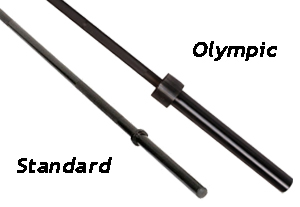 Standard weights are often found in home gyms. What you'll see right away is olympic bars are thicker on the ends. But that's actually just one of many differences.
Standard bars are exactly 1" in diameter throughout the whole length (besides the shoulders that stop the weight plates). They are made to take standard weight plates.
Standard bars weigh 13 to 19 lbs or so. That's for solid steel ones. Special "cardio" bars are hollow, only 5 lbs, and are not meant to take much weight.
Olympic bars are just short of 2" diameter on the ends (actually 1 31/32", or 50mm). As such, they will only take olympic weight plates, which have 2" diameter holes. These actually can also be divided up into olympic weightlifting and powerlifting bars, or even further, but they are often just called olympic bars.
Olympic 7ft bars are supposed to weight 45 lbs or 44 lbs (20kg). There are cheaper 7ft bars that weigh less. Shorter olympic bars, 5ft or 6ft, may weigh as little as 29 lbs. "Technique" bars are hollow or aluminum and a good choice for sticking with olympic weights but at a low starting weight as low as 10 lbs.
The Plates
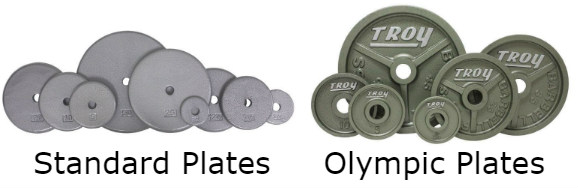
Both types can come in a variety of styles, like grip holes and rubber coating.
Both types are generally all made of the same cast iron, other than the solid rubber olympic bumper plates, and then covered with a baked-on enamel paint or a rubber or urethane coating.
Typical standard plates are the "pancake" shaped plates with rounded edges, consisting of these sizes: 1.25lb, 2.5lb, 5lb, 10lb, 12.5lb, 20lb, 25lb, 50lb. The holes are just over 1" diameter to fit on a standard bar.
Olympic plates come in pound or kilogram sizes, but in the US most are converted roughly from kilogram sizes to pounds. 1 kg = 2.2 lb.
For more detailed info, see our longer version of this article on Two Rep Cave that goes over why olympic weights are the best, why you might use standard weights, and what to watch out for with some plates marked Standard.